
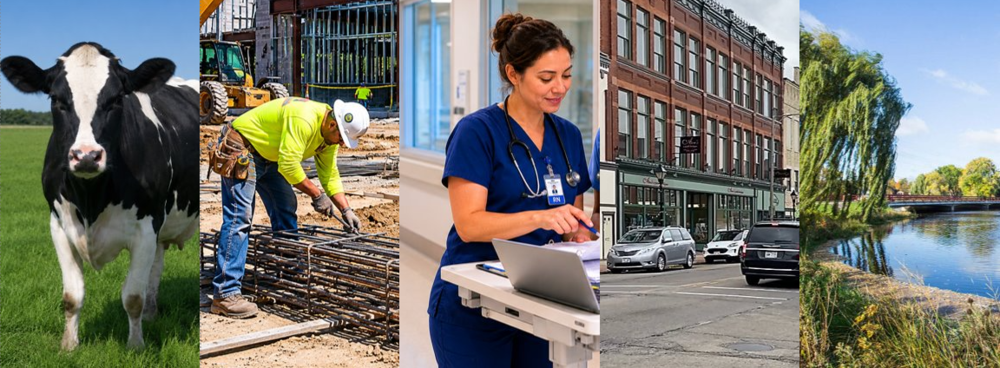
The City of Watertown today announced the rollout of its new Economic Development Plan. The comprehensive strategy aims to strengthen Watertown’s role as a vital Rural Regional Hub by focusing on five interconnected areas of opportunity: Agricultural, Skilled Trades, Healthcare, Commercial, and Recreational.
The plan opens by highlighting Watertown’s identity. In the 1850’s, a large wave of German immigrants swelled the small community to a population of over 8,500, making it the second largest city in Wisconsin and an important regional hub. Today, the community embraces its RURAL character with farming in its blood while serving as a REGIONAL center with major transportation links surrounded by a network of small communities, and a HUB for Agricultural, Skilled Trades, Healthcare, Commercial, and Recreational activities.
“Our agricultural and blue-collar roots are core to who we are,” the strategy emphasizes.
The strategy details action-oriented approaches for each of the five hubs:
Agricultural Hub – Next Gen Ag and Agritourism
Integrate advanced technologies like precision farming and bioengineering to improve soil health, crop yields, livestock productivity, and food processing.
Pursue partnerships with Ag trade associations and universities, entrepreneurship programs, and an “enterprise center” for research and startups.
Develop agritourism through growing farmer’s markets, connecting a network of local farm stands, tours at local producers, and targeted marketing.
Skilled Trades Hub
Provide the next generation of employees for the Skilled Trades, honoring Watertown’s “blue collar” tradition and local small and mid-size manufacturing in construction, electrical, HVAC, plumbing, and related skilled trades.
Develop a training facility through partnerships with MATC and Skilled Trades unions, grow the feeder programs from regional high schools, and increase apprenticeship and placement programs with local employers.
Healthcare Hub
Address the need for the next generation of care providers as Watertown’s largest employers are in healthcare and the network of providers continues to grow.
Enhance training offerings through the Watertown branch of Madison College, grow the feeder programs from regional high schools, and increase placement programs with local healthcare employers.
Commercial Hub
Commit to the vitality of the two main business districts: Downtown and South Church Street, while advancing agritourism.
Strengthen existing businesses, fill empty storefronts, enhance existing downtown buildings, develop empty parcels, improve parking, grow Farmer’s Markets, establish a network of farm stands, and offer tours at local producers.
Recreational Hub
Leverage Watertown’s wealth of recreational facilities, including Brand-Quirk Park (baseball, tennis, softball, soccer, disc golf), Riverside Park (baseball, softball, aquatic center), and the Rock River (fishing, paddle sports) to attract visitors from the region and beyond.
Partner with local athletic and sporting clubs to attract more tournaments and enhance facilities such as building up Rock River recreation opportunities with additional piers and launches.
Implementation: Already Underway and Next Steps
Work is already underway on next steps, including validation of key aspects of each hub, initial planning for each hub, networking with potential partnership organizations, and identifying specific federal and state funding sources.
The full Economic Development Strategy presentation is available for review on the City’s website at watertownwi.gov. This strategic initiative reinforces Watertown’s position as a community where opportunity runs through it, fostering economic vitality while preserving the close-knit, rural character that defines the city.